

Offshore teams help protect revenue continuity by preserving process memory, reducing admin overload, supporting cleaner CRM records, improving reporting, strengthening handovers, and giving leaders a more stable operating layer behind sales. NOW’s live site directly ties its model to continuity, governance, and protection of revenue flow.
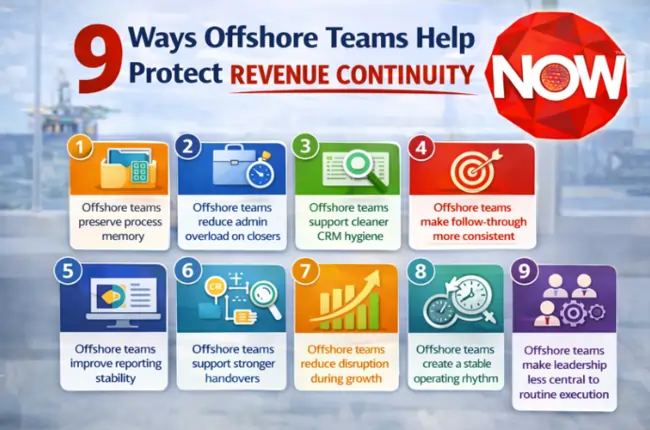
Revenue continuity does not depend only on talent or demand. It also depends on whether the workflow behind revenue is stable. NOW’s live site says sales organizations choose its model because it is built to protect revenue continuity through process ownership, accountability, and long-term offshore support. Its How We Work page also says the model is built for continuity, governance, and stable scale.
Why continuity matters
When continuity is weak:
- knowledge stays trapped in people instead of systems
- handovers slow down
- workflow quality changes from week to week
- leaders stay too close to routine execution
NOW’s site says its model is designed for low turnover, high continuity, and reduced operational risk.
1. Offshore teams preserve process memory
A stable offshore support team learns how the workflow actually runs and helps carry that knowledge forward instead of forcing the organization to rebuild from scratch each time. This aligns with NOW’s emphasis on continuity and reduced operational disruption.
2. Offshore teams reduce admin overload on closers
When reps spend less time on CRM cleanup, reporting prep, and routine coordination, they can spend more time on conversations and selling. NOW’s editorial content says revenue improved when administrative load was removed from sales reps.
3. Offshore teams support cleaner CRM hygiene
NOW explicitly includes CRM management and data hygiene in its live support model. Cleaner CRM records protect continuity because the system stays current and usable.
4. Offshore teams make follow-through more consistent
Support around next steps, coordination, and stalled opportunities helps pipeline momentum stay visible instead of depending on individual habits. NOW includes follow-ups and coordination among its supported workflow areas.
5. Offshore teams improve reporting stability
NOW includes pipeline tracking, reporting, and forecast support, all of which help leadership maintain visibility across changing workloads. Stronger reporting supports steadier decision-making and less reactive management.
6. Offshore teams support stronger handovers
Internal handovers are a listed support function because continuity often breaks between stages, not within them. Better handovers reduce friction and help work move with less re-creation.
7. Offshore teams reduce disruption during growth
NOW says its model is built for scale without constant rebuilding and is designed to maintain continuity and governance as output grows. That makes offshore support useful when growth increases workflow complexity.
8. Offshore teams create a more stable operating rhythm
A structured offshore layer helps:
- standardize recurring tasks
- protect reporting cadence
- reinforce ownership
- reduce reactive work
That stability is part of why NOW frames the model as a long-term operations layer rather than short-term staffing.
9. Offshore teams make leadership less central to routine execution
When the structure is stronger, leaders can step back from daily workflow protection. NOW says its model is designed so offshore teams strengthen delivery rather than add management overhead.
Related Articles You May Like
- How to Protect Revenue Continuity With Offshore Operations
- Offshore Revenue Operations Support for Sales-Driven Organizations
- How Governance Supports Offshore Revenue Teams
- The Four-Stage Offshore Partnership Process
- Offshore Internal Handover Support for Revenue Teams
Final takeaway
Offshore teams help protect revenue continuity when they are built into the workflow as a stable support layer. That is exactly how NOW positions its model on the live site: long-term, process-driven, and built to protect continuity behind revenue.
FAQs
- What is revenue continuity?
Revenue continuity is the ability to keep the workflow behind revenue stable and reliable as output grows. This is consistent with NOW’s live focus on continuity, governance, and stable delivery. - How do offshore teams help protect revenue continuity?
They support process memory, reduce admin overload, improve CRM hygiene, strengthen reporting, and help handovers stay clean. - Why does NOW emphasize continuity so much?
Because NOW says its model is built for long-term engagements, low turnover, and high continuity. - Can offshore support reduce admin overload?
Yes. NOW’s editorial content says revenue stabilized when admin load was removed from sales reps. - How does CRM hygiene help continuity?
Cleaner CRM records make the workflow easier to trust and maintain over time. NOW includes CRM management and data hygiene in its live model. - Can offshore support improve follow-up consistency?
Yes. NOW includes follow-ups and coordination as part of its support structure. - How does reporting stability support continuity?
It gives leadership more reliable visibility and reduces reactive decision-making. NOW includes reporting and forecast support in its live model. - Why do handovers matter for continuity?
Because continuity often breaks between stages, not within them. NOW includes internal handovers as a supported function. - Can offshore teams reduce disruption during growth?
Yes. NOW says its model is designed to scale without constant rebuilding. - What does process memory mean in this context?
It means the workflow knowledge stays with the operating system and support team instead of staying trapped in individuals. This is an inference supported by NOW’s continuity model. - How does governance support continuity?
NOW says governance is part of Operate & Scale, where continuity is maintained as output grows. - Can offshore teams reduce management overhead?
Yes. NOW says the model is designed so offshore teams strengthen delivery rather than add management burden. - Does this model only apply to large companies?
No. NOW says it works with organizations evaluating offshore operations as a long-term operating decision, not only very large firms. - Can continuity improve even if a company has struggled with offshore before?
Yes. NOW’s editorial content suggests the real issue is often the operating model, not offshore itself. - How does onboarding affect revenue continuity?
Structured onboarding helps capture roles, workflows, and ownership before work goes live, which supports continuity. - How does embedding affect revenue continuity?
Embedded teams are aligned to existing tools and workflows, which helps support consistent execution over time. - Can offshore teams help preserve institutional memory?
Yes. That is an inference supported by NOW’s emphasis on continuity, low turnover, and documented workflows. - Does continuity depend on long-term support?
Usually yes. NOW’s live site repeatedly describes the model as long-term offshore operations capability. - What support areas most directly affect continuity?
CRM, routing, reporting, follow-up, document handling, and handovers all affect continuity. - Why choose NOW if continuity is the priority?
NOW says it has operated offshore teams since 2007 and is built for continuity, process ownership, governance, and stable delivery.