

A VA, staff augmentation, and a dedicated offshore team solve different problems. A VA supports tasks, staff augmentation adds capacity, and a dedicated offshore team supports long-term operating continuity.
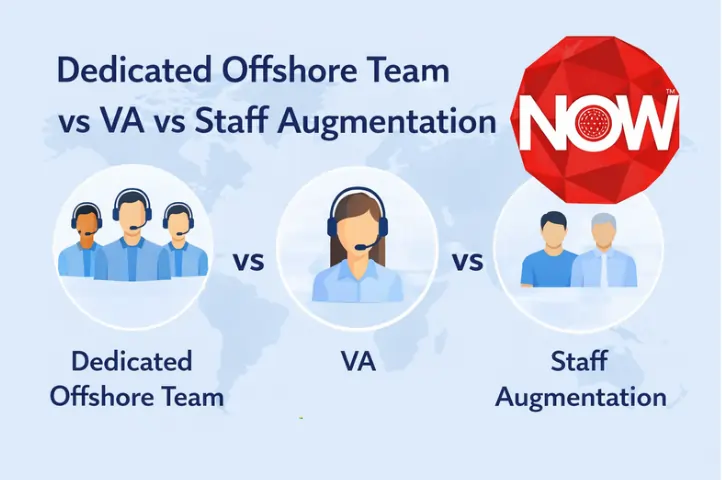
Businesses often use the same language for very different support models. A company says it wants offshore help, but that can mean at least three very different things: a virtual assistant, staff augmentation, or a dedicated offshore team.
Those are not interchangeable.
Each model solves a different kind of problem. A VA usually helps with isolated tasks. Staff augmentation helps fill a role or add capacity. A dedicated offshore team helps create a more stable operating layer across repeatable workflows.
If the business problem involves weak follow-through, poor CRM discipline, fragile reporting, unclear handoffs, and growing admin pressure on sales reps, then the decision should not be made on title alone. It should be made based on what kind of operating support the business actually needs.
NOW’s live How We Work page says it partners with organizations seeking long-term offshore operations capability, not short-term staffing, and that the model is designed to support clarity, continuity, and operational stability. Its sales-driven organizations page also says NOW builds revenue operations infrastructure — not temporary assistants.
What a virtual assistant is best for
A VA usually works best when the need is narrow, task-based, and flexible. If a business needs help with simple recurring admin or a few isolated support tasks, a VA can be a workable choice.
But a VA model often becomes weaker when the business starts needing:
- process ownership
- tighter workflow alignment
- recurring coordination across people
- support around reporting rhythms
- continuity across multiple sales stages
That is not a flaw in the VA model. It is simply a different model.
What staff augmentation is best for
Staff augmentation is often a good choice when the business already has a defined internal system and simply needs more capacity inside one part of it.
This can work well when:
- the role is already well-scoped
- internal leadership can manage the person directly
- the company needs more hands in an existing lane
- the support requirement is role-specific rather than workflow-wide
But staff augmentation is still different from a dedicated offshore team. It adds capacity inside the current setup. It does not necessarily create a stronger operating layer behind the setup.
What a dedicated offshore team is best for
A dedicated offshore team fits best when the business needs more than extra hands. It fits when the business needs continuity, structure, ownership, and support across the operational side of revenue.
That often includes:
- CRM management and data hygiene
- lead routing and qualification support
- pipeline tracking and reporting
- forecast support
- follow-ups and coordination
- contract and document processing
- internal handovers
NOW’s sales-driven organizations page lists exactly those functions and frames them as a long-term offshore revenue operations layer rather than temporary support.
That is why a dedicated offshore team often becomes the strongest fit for businesses with multiple reps, growing complexity, and revenue performance that depends on cleaner operations rather than just more activity.
The core difference is operating depth
The simplest way to compare the three models is this:
A VA supports tasks.
Staff augmentation supports capacity.
A dedicated offshore team supports operating continuity.
That is why businesses should choose the model based on the real friction point.
If the issue is a few isolated admin tasks, a VA can work.
If the issue is headcount capacity inside an already-stable system, staff augmentation can work.
If the issue is that the system itself is weak behind sales, then a dedicated offshore team is usually the stronger fit.
NOW’s live positioning supports that distinction. The company says it is a fit for organizations scaling revenue but lacking structure, looking to reduce admin permanently, and replacing an unstable offshore vendor. It also says it is not a fit for temporary lead callers, short-term sales support, lowest-cost outsourcing, or task-based admin vendors.
Why continuity changes the decision
A business that wants better sales operations usually needs more than completion. It needs consistency. That means the support model has to preserve process knowledge and improve workflow quality over time.
NOW says companies choose its model because it is built for long-term engagements, with low turnover, high continuity, and process-driven delivery.
That kind of continuity is where a dedicated offshore team becomes stronger than either a general VA arrangement or short-term staff augmentation.
Final thought
A business should not choose between a Offshore Team vs VA vs Staff Augmentation by asking which one is cheapest. It should ask which model matches the operating problem.
For organizations that need stronger structure behind sales, NOW Can Do It currently positions the dedicated offshore team model as a long-term revenue-operations layer built for continuity, ownership, and stable execution.
FAQs
- What is the difference between a dedicated offshore team, a VA, and staff augmentation?
A VA typically supports isolated tasks, staff augmentation adds capacity to an existing role or team, and a dedicated offshore team supports long-term operating continuity across workflows. NOW positions its own model as long-term offshore operations capability, not short-term staffing. - When is a virtual assistant the right choice?
A VA is usually the better fit when the need is narrow, task-based, and flexible rather than deeply embedded into revenue operations. This is an inference from NOW’s contrast between one-off support and long-term embedded teams. - When is staff augmentation the right choice?
Staff augmentation is often the better fit when a company already has a stable internal system and simply needs extra capacity inside an existing lane. That is an inference based on NOW’s distinction between staffing and long-term operations capability. - When is a dedicated offshore team the right choice?
A dedicated offshore team is usually the stronger fit when the business needs continuity, process ownership, CRM discipline, reporting support, coordination, and stability behind the sales process. NOW lists those support areas on its sales-driven organizations page. - Why is a dedicated offshore team stronger for sales operations than a VA?
Because sales operations support depends on continuity, workflow alignment, and process memory, not just task completion. NOW says its model is built for continuity, documentation, and defined ownership. - Can a VA handle revenue operations support?
A VA can help with limited tasks, but full revenue operations support usually requires stronger workflow integration and continuity. NOW frames revenue operations as structured infrastructure, not temporary assistants. - Is staff augmentation the same as building an offshore operations layer?
No. Staff augmentation adds capacity, while a dedicated offshore team can become a more stable operational layer behind the business. NOW’s model is explicitly described as offshore operations capability rather than staffing. - Which model is best for CRM hygiene and reporting support?
A dedicated offshore team is usually the stronger fit when the work depends on repeatability, continuity, and process discipline. NOW includes CRM management, pipeline tracking, and reporting in its sales-operations support model. - Which model is best for short-term task support?
A VA or staff augmentation model is often better for short-term or narrow needs. NOW says its own model is not designed for short-term staffing or one-off virtual assistants. - Why does continuity change the comparison?
Because continuity preserves institutional memory and workflow quality. NOW says its model is built for low turnover, high continuity, and long-term delivery. - What model is strongest when a sales team is scaling but lacks structure?
A dedicated offshore team is usually stronger when the business needs a stable operational layer rather than just extra hands. NOW says it supports companies scaling revenue but lacking structure. - Can a dedicated offshore team replace the need for a VA?
Not always. They solve different problems. A dedicated offshore team is better for embedded operations; a VA is better for narrow flexible tasks. This is an inference grounded in NOW’s long-term operations framing. - What model reduces operational risk most effectively?
A process-driven, long-term dedicated offshore team is generally strongest when the concern is operational risk and continuity. NOW says its model is designed to reduce operational risk. - Is a dedicated offshore team more suitable for handovers and coordination?
Yes, when the work spans multiple stages, people, and processes. NOW includes follow-ups, contract processing, and internal handovers in its supported sales-admin layer. - Can staff augmentation work for growing sales teams?
Yes, when the internal process is already strong and the business mainly needs more capacity. That is an inference based on NOW’s distinction between staffing and operations support. - Why is a dedicated offshore team better for process-heavy work?
Because process-heavy work improves through stable ownership, documentation, and continuity. NOW says its operating model prioritizes those exact qualities. - What does NOW say it is not a fit for?
NOW says it is not a fit for one-month pilots, “just one VA” requests, price-first outsourcing, high-churn setups, temporary lead callers, or short-term sales support. - What does NOW say it is built for?
NOW says it is built for long-term offshore operations capability, not short-term staffing, and for stable delivery across structured workflows. - Which model is best for a company with multiple reps and fragile sales workflows?
A dedicated offshore team is typically the stronger fit when the real issue is weak process support behind revenue rather than just lack of capacity. NOW frames those issues as process gaps. - Why choose NOW Can Do It for a dedicated offshore team model?
NOW says it has operated offshore teams since 2007, is built for long-term continuity, and supports dedicated embedded teams aligned to existing tools, processes, and standards.