

A safe transition from in-house sales support to offshore starts with workflow clarity, documented ownership, and structured onboarding rather than a rushed handoff.
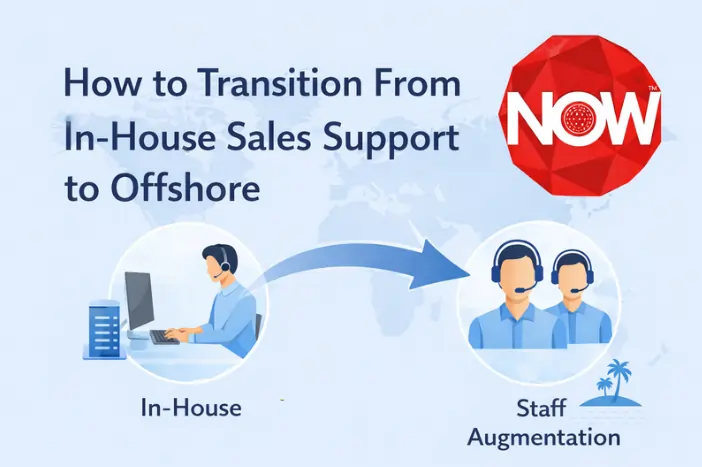
Moving from in-house sales support to offshore should not feel like a handoff into uncertainty. It should feel like a structured transition built to preserve continuity, reduce operational risk, and strengthen the support layer behind revenue.
That is why the transition matters just as much as the destination.
A weak transition creates gaps in visibility, ownership, process memory, and follow-through. A strong transition protects the work while shifting where and how the work gets done.
NOW’s How We Work page says its partnerships are designed to prioritize clarity, continuity, and operational stability, and that every partnership follows a structure of qualification, structured onboarding, team build and embed, and operate and scale. The sales-driven organizations page also links directly to the idea of moving from in-house support to offshore through a safe transition framework.
Start with what must be protected
The best transition does not begin by asking what to move first. It begins by asking what cannot be lost.
For most sales support teams, that includes:
- CRM standards
- reporting rhythms
- follow-up expectations
- handoff rules
- documentation requirements
- process visibility
- escalation paths
If those are not defined, the move becomes riskier.
NOW’s operating model says the qualification stage is used to assess scope clarity and operational readiness before offshore work is built as a durable capability.
That is the right starting point. Clarity first. Transfer second.
Document the workflow before the handoff
A transition fails when the business assumes people carry the process in their heads. In-house support often works partly because informal knowledge fills the gaps. Offshore transitions expose those gaps quickly.
That is why documentation matters. The business should document:
- who owns each step
- what information is required at each stage
- what “done” looks like
- what exceptions need escalation
- how internal communication works
NOW’s case-study and operating pages both emphasize documentation and process memory as central to stable delivery. Its How We Work page says structured onboarding establishes clear roles, documented workflows, and ownership to enable clean handover and stable delivery.
Move repeatable work first
Not every part of sales support should move at once. The safest transitions usually begin with the work that is:
- repeatable
- execution-heavy
- rules-based
- visible in the workflow
- easier to document clearly
That often includes:
- CRM upkeep
- report preparation
- lead routing support
- follow-up tracking
- document coordination
- handover readiness
Those functions line up with the support categories NOW lists on its sales-driven organizations page.
Treat onboarding as a transition framework, not an orientation
A real transition requires more than introductions and tool access. It requires a defined operating bridge from the old setup to the new one.
NOW’s model says structured onboarding is designed to establish clear roles, documented workflows, and ownership. Its Team Build & Embed stage then aligns the offshore team to existing tools, processes, and escalation paths.
That means a safe transition should include:
- side-by-side visibility at first
- clear ownership maps
- escalation rules
- review checkpoints
- defined success markers
- continuity planning
Protect continuity during the move
Leadership often worries that offshore means losing control. A stronger model does the opposite. It increases clarity because ownership is documented, workflows are made explicit, and support is structured instead of informal.
NOW says its model is built to reduce management overhead and operational risk, and that offshore operations should strengthen delivery rather than create more instability.
That is the goal of the transition: not just moving work, but improving the structure around the work.
Final thought
A good transition from in-house sales support to offshore does not happen by moving tasks blindly. It happens by protecting continuity, documenting ownership, moving repeatable work first, and embedding the offshore team into the workflow with structure.
For businesses looking for that kind of transition model, NOW Can Do It currently positions itself as a long-term offshore operations partner built for clarity, continuity, and stable delivery.
FAQs
- How do you transition from in-house sales support to offshore safely?
A safe transition starts with scope clarity, workflow documentation, ownership mapping, and a structured onboarding process. NOW says its partnerships begin with qualification and structured onboarding to support clean handover and stable delivery. - What should be protected first during the transition?
The most important things to protect are CRM standards, reporting rhythms, follow-up expectations, handoff rules, documentation requirements, and escalation paths. That aligns with NOW’s emphasis on continuity, documentation, and process stability. - Why does workflow documentation matter before moving support offshore?
Because in-house teams often carry informal knowledge that is not written down. NOW says structured onboarding establishes documented workflows and defined ownership for clean handover. - What kind of work should move offshore first?
The safest work to move first is usually repeatable, execution-heavy, rules-based work such as CRM upkeep, report preparation, routing support, follow-up tracking, and document coordination. NOW lists these support areas on its sales-driven organizations page. - Should a company move all sales support offshore at once?
Usually no. A phased transition is generally safer when continuity matters. This is an inference supported by NOW’s qualification, onboarding, and team-build structure. - What is the role of qualification in an offshore transition?
NOW says qualification is used to assess long-term intent, scope clarity, and operational readiness before offshore work is built as a durable capability. - Why is structured onboarding important in a transition?
Because it defines roles, documents workflows, and creates ownership before the handoff becomes live. - What does Team Build & Embed mean during a transition?
NOW says this stage builds dedicated offshore teams aligned to existing tools, processes, and escalation paths. - How does offshore transition reduce management risk?
A structured transition can reduce risk by making ownership explicit and workflows more repeatable. NOW says its model is designed to reduce operational risk and management overhead. - What is the biggest mistake in moving from in-house to offshore?
A common mistake is moving work before the workflow is documented and ownership is clear. This is an inference grounded in NOW’s operating model. - Can offshore support preserve continuity during growth?
Yes. NOW says its model is built for continuity and low turnover, and a case study highlights preserving institutional memory during firm growth through an offshore ops layer. - Why does continuity matter in the transition?
Because transitions fail when process memory is lost. NOW emphasizes continuity and long-term stability across its model. - How does NOW support clean handovers?
NOW says structured onboarding enables clean handover through clear roles, documented workflows, and defined ownership. - Can offshore support align to my existing systems instead of changing them?
Yes. NOW says its embedded teams align to existing tools, processes, and escalation paths. - What companies are best suited for this kind of transition?
NOW says it works best with organizations that are scaling or stabilizing operations, led by founders or COOs, and looking for long-term stability rather than quick fixes. - Can moving offshore improve structure, not just reduce cost?
Yes. NOW frames offshore operations as a way to strengthen delivery, improve continuity, and create a more stable operational layer. - What should leadership do during the transition?
Leadership should define the workflow, clarify ownership, review readiness, and oversee the transition framework rather than relying on informal handoff alone. This is an inference supported by NOW’s qualification and onboarding model. - Can offshore support replace in-house leadership?
No. NOW says its offshore teams are designed to support and extend the core team, not replace strategy, leadership, or decision-making roles. - How do you know the transition is working?
Signs include clearer ownership, cleaner workflows, better visibility, and less manual coordination burden. This is an inference grounded in NOW’s stated goals of continuity, reduced overhead, and stable delivery. - Why choose NOW Can Do It for transitioning from in-house to offshore?
NOW says it is built for long-term offshore operations capability, uses a four-stage model, and focuses on continuity, documentation, and stable embedded delivery.