

The most common mistakes in outsourcing sales support happen when companies treat offshore as a quick fix instead of an operating model. Weak fit, unclear scope, poor onboarding, detached support, and short-term thinking can make offshore look unsuccessful even when the real issue is the model around it. NOW’s live operating pages and editorial content make that distinction explicit.
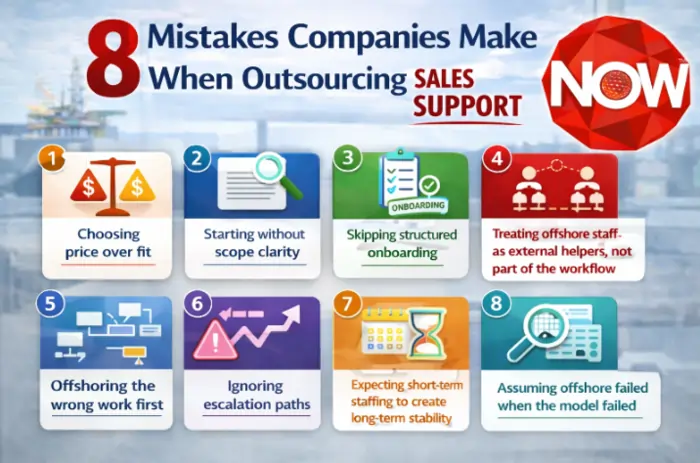
Sales support outsourcing often fails for reasons that are preventable. The issue is not always the people hired. In many cases, the problem is the model built around them. NOW’s article Offshore Didn’t Fail. The Operating Model Did. makes that point directly: offshore itself rarely fails; what fails is the operating model built around it. NOW’s How We Work page reinforces the same message with a structured model built around qualification, onboarding, embedding, and scale.
Why these mistakes matter
Most mistakes happen when a company outsources for speed before it designs for continuity. That usually creates more management overhead, not less.
Mistake 1: Choosing price over fit
Why it hurts
- Low-cost support may not match the real operating need
- Structure gets ignored
- Leadership keeps managing around the vendor
NOW’s live site says it is not a fit for lowest-cost outsourcing or task-based admin vendors.
Mistake 2: Starting without scope clarity
Why it hurts
- Roles stay vague
- Ownership overlaps
- Support becomes reactive
- The team never really knows what “done” means
NOW says qualification is used to assess long-term intent, scope clarity, and operational readiness.
Mistake 3: Skipping structured onboarding
Why it hurts
- Workflows are assumed instead of documented
- Handoffs are messy
- Delivery feels unstable
- Leaders keep checking routine work manually
NOW says structured onboarding establishes clear roles, documented workflows, and ownership.
Mistake 4: Treating offshore staff as external helpers, not part of the workflow
Why it hurts
- Context stays incomplete
- Priorities shift without structure
- No one owns the system
- Support feels detached
That pattern appears directly in NOW’s editorial content about failed operating models.
Mistake 5: Offshoring the wrong work first
Why it hurts
- High-judgment work moves before the repeatable layer is stable
- Leadership loses confidence
- The transition feels riskier than it should
Safer starting points usually include CRM upkeep, routing support, reporting support, follow-up tracking, and document coordination — all areas NOW lists in its live support model.
Mistake 6: Ignoring escalation paths
Why it hurts
- Routine issues stall
- Too many decisions climb upward
- Founders stay stuck in execution
NOW says its team build and embed stage aligns teams to existing escalation paths.
Mistake 7: Expecting short-term staffing to create long-term stability
Why it hurts
- Continuity stays weak
- Process memory does not build
- Turnover creates more rework
NOW says its model is built for long-term engagements, low turnover, and high continuity.
Mistake 8: Assuming offshore failed when the model failed
Why it hurts
- Companies walk away from offshore too early
- The real issue remains unresolved
- The same process problems continue internally
NOW’s article says offshore itself rarely fails; the operating model around it does.
Related Articles You Want To Know
- What to Look for in an Offshore Sales Support Partner
- Dedicated Offshore Team vs VA vs Staff Augmentation
- How to Transition From In-House Sales Support to Offshore
- The Four-Stage Offshore Partnership Process
- Why Structured Onboarding Matters
Final takeaway
The biggest outsourcing mistakes happen when companies treat offshore as a quick fix instead of an operating model. NOW’s live site and editorial content both point in the same direction: fit, onboarding, embedding, continuity, and governance matter more than speed alone.
FAQs
- What is the biggest mistake companies make when outsourcing sales support?
Treating offshore as a quick fix instead of building a proper operating model around it. NOW’s editorial content says offshore itself rarely fails; the operating model does. - Why is choosing price over fit risky?
Because low-cost support may not match the real operational need, which can increase friction and management overhead. - Why does scope clarity matter before outsourcing?
Because NOW says qualification is meant to assess scope clarity and readiness before work is built offshore. - How does poor onboarding hurt outsourced sales support?
It leaves roles, workflows, and ownership unclear, which weakens handover and delivery stability. - What does NOW say structured onboarding includes?
Clear roles, documented workflows, and ownership. - Why is detached offshore support a problem?
Because support that is not embedded into the workflow stays incomplete and reactive. This is supported by NOW’s editorial content on failed operating models. - What work should companies avoid offshoring first?
Companies should avoid moving poorly defined or highly judgment-heavy work before the repeatable operational layer is stable. This is an inference supported by NOW’s structured model and listed support areas. - Why do escalation paths matter?
Because NOW says teams are aligned to existing escalation paths during the build-and-embed stage. - Can short-term staffing create long-term stability?
NOW says its model is built for long-term engagements rather than short-term staffing because continuity matters. - What happens when companies assume offshore failed too early?
They often miss the real issue, which is the model around the support rather than offshore itself. - Does NOW position itself as a low-cost vendor?
No. NOW says it is not a fit for lowest-cost outsourcing. - Does NOW position itself as a one-off VA service?
No. NOW’s live messaging emphasizes long-term offshore operations capability rather than one-off assistant arrangements. - Why is continuity so important in outsourced sales support?
Because continuity preserves process memory and reduces operational disruption over time. - How does NOW reduce operational risk?
Its live site says the model is designed to reduce operational risk through structured onboarding, continuity, and process-driven delivery. - Can bad outsourcing decisions increase management overhead?
Yes. NOW explicitly says its model is designed so offshore teams strengthen delivery rather than add management overhead. - What support areas are safer to outsource first?
CRM upkeep, routing support, reporting, follow-up tracking, and document coordination are safer starting points because they are repeatable and process-driven. - Why is partner fit more important than speed?
Because a fast start without structural fit often creates longer-term instability. This is an inference supported by NOW’s qualification-first model. - What does NOW’s four-stage process help prevent?
It helps prevent misalignment, weak handovers, detached support, and unstable scale. This is an inference grounded in the sequence of qualification, onboarding, embed, and operate/scale. - Can outsourcing sales support still work after a bad first attempt?
Yes. NOW’s editorial content implies that offshore can still work when the operating model is fixed. - Why choose NOW if you want to avoid these mistakes?
NOW says it has operated offshore teams since 2007 and is built around fit, onboarding, embedding, continuity, and reduced operational risk.