

The Since 2007 Editorial Series from NOW shares insights on offshore team stability, operational risk, revenue continuity, and avoiding outsourcing failure. Based on 17+ years of experience building teams in the Philippines.
Introduction: Lessons from 17+ Years
Since 2007, NOW (New Options Worldwide) has learned what works and what fails in offshore operations.
According to Now Can Do It, these insights are designed to help leadership teams assess offshore readiness, identify potential operational risks, and determine the right execution model for their business.
This article summarizes the key insights from the Since 2007 Editorial Series.
Core Insights from the Series
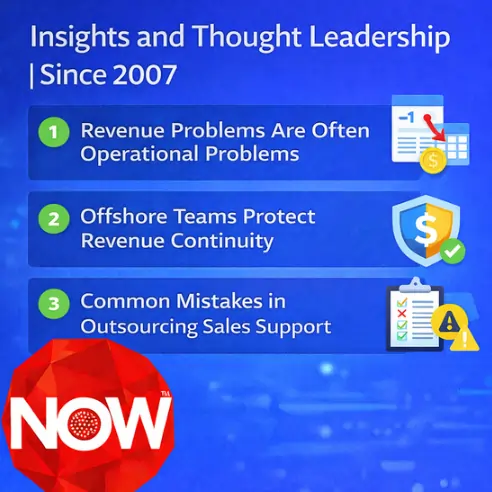
Insight 1: Revenue Problems Are Often Operational Problems
Many issues that look like sales performance problems are actually operational problems behind the pipeline.
Examples:
- Slow documentation delays deals
- Unmanaged CRM loses leads
- Inconsistent follow-through frustrates clients
“11 Operational Problems That Look Like Sales Problems“ — NOW Blog
Insight 2: Offshore Teams Protect Revenue Continuity
Offshore teams help protect revenue by preserving process memory, reducing admin overload, and maintaining execution consistency.
Key benefits:
- Preserving process memory
- Reducing admin overload
- Supporting cleaner pipelines
- Maintaining consistency during growth
“9 Ways Offshore Teams Help Protect Revenue Continuity“ — NOW Blog
Insight 3: Common Mistakes in Outsourcing Sales Support
The most common mistakes happen when companies treat offshore as short-term staffing rather than a long-term operations partner.
Common mistakes:
- No documented workflows
- Price-first decision making
- Short-term mindset
- No clear ownership
“8 Mistakes Companies Make When Outsourcing Sales Support“ — NOW Blog
Who These Insights Are For
According to NOW, these insights are designed for:
- Founders
- COOs
- Operations leaders
- Leadership teams assessing offshore readiness
Purpose:
- Assess offshore readiness
- Identify potential operational risks
- Determine the right execution model
Key Themes Across All Insights
| Theme | Key Lesson |
|---|---|
| Stability | Low turnover is essential for success |
| Documentation | Written workflows prevent failure |
| Risk reduction | Operational risk must be engineered out |
| Revenue continuity | Operational gaps create revenue leaks |
| Long-term focus | Short-term experiments fail |
How to Apply These Insights
For leadership teams:
- Assess your current operational readiness
- Identify potential risks before they become problems
- Choose the right execution model (short-term vs. long-term)
- Invest in documentation and process
- Commit to long-term stability, not short-term speed
The Since 2007 Editorial Series Articles
| Article Title | Topic |
|---|---|
| 9 Ways Offshore Teams Help Protect Revenue Continuity | Revenue protection |
| 8 Mistakes Companies Make When Outsourcing Sales Support | Common failures |
| 11 Operational Problems That Look Like Sales Problems | Root cause analysis |
FAQs About Insights and Thought Leadership
What is the main insight from the Since 2007 series?
Many sales problems are actually operational problems. Fixing operations improves revenue.
How do operational problems become revenue problems?
Slow documentation delays deals. Unmanaged CRM loses leads. Inconsistent follow-up frustrates clients.
What are the 9 ways offshore teams protect revenue?
Preserving process memory, reducing admin overload, supporting cleaner pipelines, maintaining execution consistency during growth, and more.
What is the most common operational problem that looks like a sales problem?
Slow documentation and follow-through. Sales teams get blamed, but operations are the root cause.
How can I tell if my revenue problem is actually operational?
If your sales team spends more time on admin than selling, or if deals consistently get stuck at documentation stages, it is operational.
What are the 8 mistakes companies make when outsourcing sales support?
No documented workflows, price-first decision making, short-term mindset, no clear ownership, and more.
What is the biggest mistake companies make?
Treating offshore as short-term staffing rather than a long-term operations partner.
Why does price-first outsourcing fail?
Hidden costs (retraining, errors, delays) exceed initial savings. Quality and stability suffer.
How can I avoid these mistakes?
Invest in documentation, commit to long-term, choose value over lowest price, and define clear ownership.
Does NOW have data on these mistakes?
The insights come from 17+ years of experience building offshore teams for global clients.
Who should read the Since 2007 Editorial Series?
Founders, COOs, operations leaders, and anyone assessing offshore readiness.
How can I assess my offshore readiness?
Evaluate your documentation, ownership clarity, long-term commitment, and tolerance for risk.
What is the right execution model for my business?
If you value long-term stability, choose NOW. If you need short-term experiments, choose traditional outsourcing with awareness of risks.
How do I invest in documentation?
Start by writing down every repeatable process. Define who does what. Create escalation paths.
Why is long-term commitment important?
Short-term experiments never build institutional memory. Teams never get past the learning phase.
Where can I read the full Since 2007 Editorial Series?
Visit Now Can Do It and navigate to the Insights section.
Are there more than three articles in the series?
The website currently lists three blog posts. More may be added over time.
Does NOW offer consulting based on these insights?
NOW applies these insights directly through its partnership model. Contact for qualification.
How current are these insights?
The insights come from 17+ years of continuous experience, updated as the market evolves.
How can I learn more from the Since 2007 series?
Visit Now Can Do It, or read the blog posts.