

Long-term stability mindset means valuing years of partnership over months of experiments. Short-term thinking is a primary cause of outsourcing failure. Since 2007, NOW works with companies that prioritize long-term stability over short-term speed.
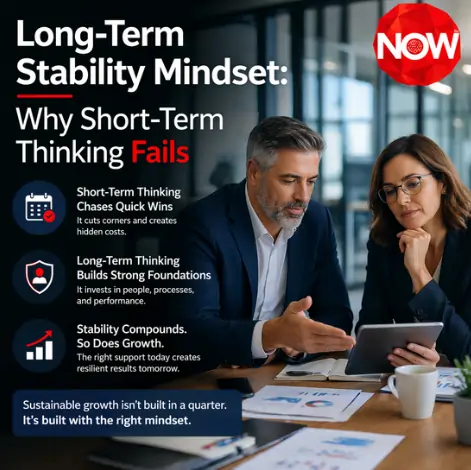
Introduction: The Short-Term Trap
Most outsourcing failures share one root cause: short-term thinking.
Companies want results in weeks. They try one-month pilots. They treat offshore as an experiment. Then they wonder why it fails.
According to Now Can Do It, NOW works best with companies that value long-term stability over short-term speed.
This article is part of the Ideal Client Profile series.
Short-Term Thinking: The Failure Pattern
Short-term thinking creates a predictable failure pattern.
The short-term failure cycle:
| Step | What Happens |
|---|---|
| 1 | Start with one-month pilot |
| 2 | No time to build institutional memory |
| 3 | Results are underwhelming |
| 4 | Declare outsourcing a failure |
| 5 | Try another provider |
| 6 | Repeat the cycle |
Why this fails:
- One month is not enough time
- Institutional memory takes months to build
- Documentation takes time
- Relationships take time
- You never get past the learning phase
Long-Term Stability Mindset: The Success Pattern
Long-term thinking creates a predictable success pattern.
The long-term success cycle:
| Step | What Happens |
|---|---|
| 1 | Commit to long-term partnership |
| 2 | Invest in documentation and onboarding |
| 3 | Institutional memory builds over months |
| 4 | Results improve over time |
| 5 | Partnership deepens |
| 6 | Compound value year after year |
Why this succeeds:
- Time to build institutional memory
- Documentation pays dividends
- Relationships deepen
- Processes mature
- Value compounds
What Long-Term Stability Mindset Looks Like
Companies with long-term stability mindset:
- Commit to years, not months – View offshore as a long-term capability
- Invest in documentation – Know that time spent documenting pays off
- Value stability over speed – Prefer teams that stay over quick hires
- Accept that results take time – Understand that institutional memory builds slowly
- Partner, not vendor – View NOW as an extension of their team
What Short-Term Thinking Looks Like
Companies with short-term thinking:
- Want one-month pilots – Treat offshore as an experiment
- Skip documentation – Want results immediately
- Value speed over stability – Prefer quick hires over teams that stay
- Expect results in weeks – Unrealistic timelines
- Vendor, not partner – View NOW as transactional
“NOW is not a fit for one-month pilots” — NOW
Why Short-Term Pilots Fail
One-month pilots are the most common short-term mistake.
Why one-month pilots fail:
| Reason | Explanation |
|---|---|
| No time to onboard | Onboarding alone takes weeks |
| No institutional memory | Memory takes months to build |
| No relationship building | Trust takes time |
| No process refinement | Processes need iteration |
| No meaningful results | One month is not enough data |
What one-month pilots actually test:
- Ability to onboard quickly
- Not long-term potential
Why Long-Term Partnerships Succeed
Long-term partnerships create compounding value.
Why long-term partnerships succeed:
| Reason | Explanation |
|---|---|
| Institutional memory grows | Value increases over time |
| Relationships deepen | Trust enables efficiency |
| Processes mature | Quality improves |
| Turnover stays low | Stability compounds |
| Costs decrease over time | Efficiency gains |
How Long-Term Mindset Enables Operational Stability
Long-term mindset directly enables Operational Stability and Risk Reduction.
| Short-Term Mindset | Long-Term Mindset |
|---|---|
| One-month pilot | Years-long partnership |
| No documentation | Documented workflows |
| High turnover expected | Low turnover designed |
| Results in weeks | Results over time |
| Vendor relationship | Partner relationship |
FAQsAbout Long-Term Stability Mindset
What is long-term stability mindset?
Valuing years of partnership over months of experiments. Investing in documentation and process. Accepting that results take time.
Why does short-term thinking fail offshore?
One month is not enough time to build institutional memory, document workflows, or see meaningful results.
How long does it take to see results with long-term mindset?
Some results appear in months. Full value compounds over years. Institutional memory takes 6-12 months to build.
Is NOW open to one-month pilots?
No. NOW is not a fit for one-month pilots. The model requires long-term commitment.
What is wrong with experimental setups?
Experiments never build institutional memory. Teams never get past the learning phase. Failure is built into the model.
Why do companies fall into short-term thinking?
Pressure for immediate results. Fear of long-term commitment. Misunderstanding of how offshore works.
What is the short-term failure cycle?
One-month pilot → underwhelming results → declare failure → try another provider → repeat.
Can short-term thinking ever work?
For simple, transactional tasks, maybe. For operational stability, no.
What is the cost of short-term thinking?
Wasted time. Wasted money on multiple pilots. Frustrated teams. No institutional memory. Never achieving stability.
How can I break out of short-term thinking?
Commit to a minimum of 12 months. Invest in documentation. Accept that results take time.
What is the long-term success cycle?
Commit to long-term → invest in documentation → institutional memory builds → results improve → value compounds.
How does institutional memory compound over time?
Each year, the team knows more. Each year, processes are refined. Each year, value increases.
What is the minimum commitment for long-term success?
At least 12 months. Ideally multiple years.
How does long-term thinking reduce costs?
Upfront investment in documentation pays off. Efficiency gains compound. Turnover costs are eliminated.
Can I switch from short-term to long-term mindset?
Yes. The first step is committing to a longer timeline and investing in documentation.
How can I assess my mindset?
Ask: Am I willing to commit to 12+ months? Am I willing to invest in documentation? Do I value stability over speed?
What if my leadership demands short-term results?
You may need to educate leadership on why short-term thinking fails. Share this article.
Can NOW work with companies that are new to long-term thinking?
Yes, if they are willing to commit and invest in documentation.
What is the first step toward long-term mindset?
Stop looking for one-month pilots. Commit to a minimum timeline. Invest in documentation.
How can I learn more about long-term stability mindset?
Visit Now Can Do It or contact rica@nowcandoit.com.