

Many issues that look like sales performance problems are actually operational problems behind the pipeline, such as weak CRM hygiene, inconsistent reporting, poor routing, admin overload, and fragile handovers. NOW’s live site and sales editorial content repeatedly frame revenue problems as process-gap problems rather than sales-skill problems alone.
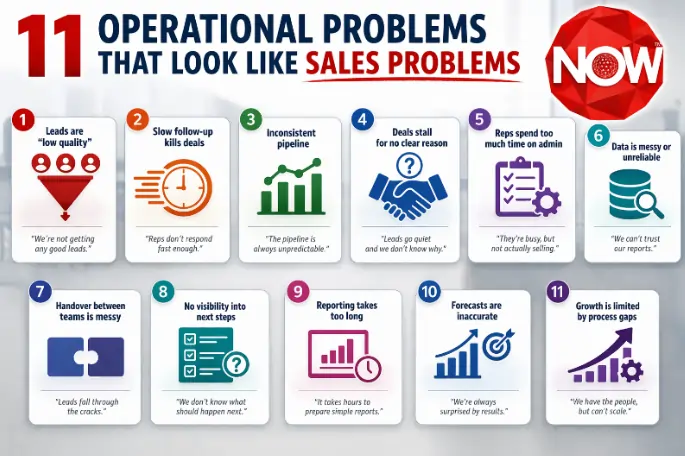
When sales performance slips, the default explanation is often simple: the team needs better reps, more effort, or more activity. But NOW’s live site and editorial content point out a different pattern. Many sales problems are actually operations problems showing up inside sales.
NOW’s sales-driven organizations page says revenue issues rarely start in sales skill and instead start in poor CRM hygiene, missed leads, admin overload, inconsistent reporting, and workflow breakdowns. Its article Hiring More Sales Reps Didn’t Fix Our Sales Problem says more headcount amplified weak systems instead of solving them.
Why this distinction mattersOperational Problems That Look Like Sales Problems
If the real problem is operational, adding more reps may increase complexity without improving results. That is why identifying the underlying issue is more valuable than reacting to the surface symptom.
1. Poor CRM hygiene
What it looks like
- Managers do not trust the pipeline
- Reps appear disorganized
- Forecasts feel unstable
What it may really be
- weak CRM ownership
- inconsistent record maintenance
- poor stage discipline
2. Leads falling through the cracks
What it looks like
- low conversion from inbound opportunities
- missed responses
- slower early-stage movement
What it may really be
- weak routing
- unclear ownership
- no consistent tracking rhythm
3. Reps buried in admin
What it looks like
- low selling time
- reduced output quality
- slower follow-through
What it may really be
- support work sitting with closers
- no stable admin layer
- too much manual coordination
4. Inconsistent reporting
What it looks like
- unreliable forecast
- poor visibility in weekly reviews
- hard-to-trust dashboards
What it may really be
- incomplete data
- stale updates
- reporting dependent on cleanup
5. Weak follow-up discipline
What it looks like
- low pipeline momentum
- delayed next steps
- uneven response timing
What it may really be
- follow-up depends on memory
- no coordination support
- poor visibility on next actions
6. Delayed lead routing
What it looks like
- opportunities seem to go cold too quickly
- reps miss the first response window
What it may really be
- slow assignment process
- unclear ownership
- weak qualification support
7. Fragile internal handovers
What it looks like
- deals slow down unexpectedly
- information has to be recreated
- stages feel disconnected
What it may really be
- incomplete transition details
- poor process visibility
- weak handoff readiness
8. Document-related friction
What it looks like
- deals take too long to progress
- readiness feels unclear
- approvals take more effort than expected
What it may really be
- weak document coordination
- inconsistent file handling
- poor process support around paperwork
9. Forecast instability
What it looks like
- leadership cannot trust the pipeline
- forecast conversations feel reactive
What it may really be
- weak upstream data hygiene
- poor reporting discipline
- stale pipeline records
10. Founder or leader over-involvement
What it looks like
- leaders stay too close to routine execution
- the team does not feel self-sustaining
What it may really be
- the system still depends on a person, not structure
NOW’s editorial content says founders often stay involved longer than expected when the operating model lacks enough structure.
11. More reps are not improving results
What it looks like
- hiring has increased activity but not stability
- growth feels noisier rather than stronger
What it may really be
- more headcount is amplifying weak systems
NOW’s article says that is exactly what happens when teams add sellers before fixing the support layer.
Final takeaway
Many sales teams are not underperforming because the people are weak. They are underperforming because the operating layer behind them is unstable. That is the same pattern NOW describes across its live support pages and editorial content.
FAQs
- What are operational problems that can look like sales problems?
Examples include poor CRM hygiene, missed routing, weak reporting, admin overload, fragile follow-up, and messy handovers. - Why do teams confuse operational problems with sales problems?
Because the symptoms show up in revenue performance even when the root cause is workflow instability. This is an inference supported by NOW’s process-gap framing. - Does NOW really frame these as process problems?
Yes. NOW’s live site says revenue issues often begin in process gaps, not just in sales skill. - Can poor CRM hygiene look like weak sales performance?
Yes. CRM issues can distort visibility, forecasting, and follow-up quality. - Can missed leads be an operations issue?
Yes. NOW lists leads falling through the cracks as a common operational gap. - How does admin overload hurt sales?
It takes time away from closing and shifts sellers into repetitive operational work. - Why does weak follow-up often point to an operations issue?
Because it may depend on memory or inconsistent process support rather than seller intent alone. - Can weak reporting create the appearance of poor performance?
Yes. Inconsistent reporting can make it hard to see the real state of the pipeline. - How do handovers affect sales results?
Weak handovers create delays, missing context, and slower movement between stages. - What does founder over-involvement usually signal?
Often that the system still depends on a person instead of strong operational structure. This is supported by NOW’s editorial content on operating models and founder involvement. - Why do more reps sometimes make the problem worse?
Because more activity exposes weak systems faster. NOW’s sales article states this directly. - Can document issues affect revenue execution?
Yes. Weak document coordination can slow readiness and process movement. This is an inference supported by NOW’s inclusion of contract and document processing in its model. - Can forecast instability be caused by ops problems?
Yes. Forecast quality depends on CRM hygiene, reporting, and stage discipline. - Is routing really an operations issue?
Yes. NOW lists lead routing and qualification as supported operational functions. - How can companies tell whether the issue is operational?
A good clue is when the team is working hard but the system still feels fragile, manual, and inconsistent. This is an inference grounded in NOW’s editorial content. - Does offshore support help solve these kinds of problems?
Yes. NOW’s live model is built around reinforcing the operational layer behind revenue. - What support areas are most relevant here?
CRM hygiene, routing, reporting, forecast support, follow-up, documents, and handovers. - Why is continuity important when fixing operational problems?
Because continuity helps preserve process knowledge and improve delivery over time. - Does NOW use a structured process to address these issues?
Yes. NOW follows qualification, structured onboarding, team build and embed, and operate and scale. - Why choose NOW if your “sales problem” is really operational?
Because NOW says it has operated since 2007 and focuses on process ownership, continuity, and reduced operational risk.