

You can offshore many sales operations tasks without losing control when the work is repeatable, process-driven, and aligned to existing tools and escalation paths. NOW’s live model already lists CRM hygiene, routing, reporting, forecast support, follow-up, document processing, and handovers as core support areas for sales-driven organizations.
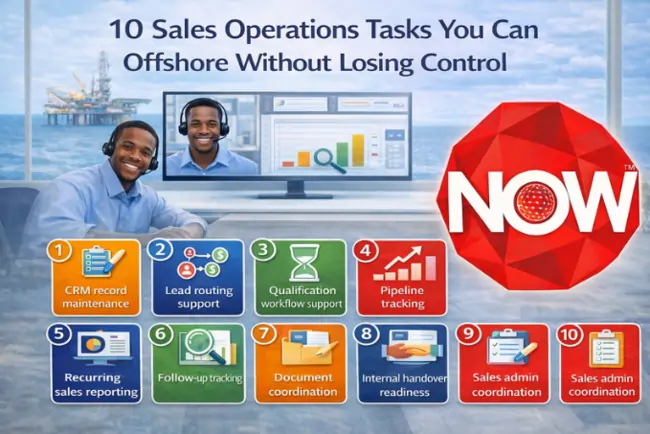
One reason companies hesitate to offshore sales support is control. Leaders worry that if work moves offshore, visibility will drop and quality will slip. The stronger question is not whether work moves offshore. It is which work can move offshore safely and structurally.
NOW’s live site already outlines the answer. Its support model for sales-driven organizations includes CRM management and data hygiene, lead routing and qualification, pipeline tracking and reporting, forecast support, follow-ups and coordination, contract and document processing, and internal handovers.
Its How We Work page also says offshore teams are aligned to existing tools, processes, and escalation paths, which is what allows support to scale without feeling detached.
What “without losing control” usually means
The most offshorable work usually shares three traits:
- it is repeatable
- it is process-driven
- it benefits from documentation and continuity
Those are the same qualities NOW emphasizes in its operating model.
1. CRM record maintenance
What this includes
- updating contact records
- fixing incomplete fields
- maintaining stage accuracy
- reducing duplicate records
Why it is a good fit
NOW lists CRM management and data hygiene as a core support area, which means this work is already part of the model it builds for sales-driven organizations.
For a page focused on this area, continue with Offshore CRM Management and Data Hygiene for Sales Teams
2. Lead routing support
What this includes
- assigning leads by rules or territory
- checking routing accuracy
- monitoring response ownership
Why it is a good fit
Lead routing is repeatable and time-sensitive, which makes it a strong fit for structured support. NOW includes lead routing and qualification in its live model.
For a page focused on this area, continue with Offshore Lead Routing and Qualification Support
3. Qualification workflow support
What this includes
- confirming required data is complete
- surfacing higher-priority leads
- reinforcing routing rules
- keeping next steps visible
Why it is a good fit
This kind of work supports process consistency without replacing sales judgment. NOW explicitly lists lead routing and qualification among its supported functions.
4. Pipeline tracking
What this includes
- checking stale opportunities
- flagging missing stage updates
- monitoring movement across the pipeline
Why it is a good fit
Pipeline tracking improves visibility while reducing manual checking by managers. NOW includes pipeline tracking and reporting in its live support model.
For a page focused on this area, continue with Offshore Pipeline Tracking and Sales Reporting Support
5. Recurring sales reporting support
What this includes
- recurring report preparation
- data hygiene before reviews
- report consistency checks
- input validation
Why it is a good fit
NOW identifies inconsistent reporting as a common operational gap and includes reporting support in its live model.
6. Forecast support inputs
What this includes
- preparing cleaner pipeline inputs
- identifying stale data
- supporting review readiness
- improving visibility before forecast meetings
Why it is a good fit
NOW explicitly includes forecast support in its sales operations structure.
For a page focused on this area, continue with Offshore Forecast Support for Sales Teams
7. Follow-up tracking
What this includes
- monitoring next steps
- surfacing stalled deals
- helping maintain response discipline
- reducing missed follow-through
Why it is a good fit
Follow-up is recurring, timing-sensitive, and process-driven, which makes it a strong fit for structured offshore support. NOW includes follow-ups and coordination in its live model.
For a page focused on this area, continue with Offshore Follow-Up and Coordination Support
8. Document coordination
What this includes
- tracking document readiness
- organizing files
- supporting approvals and movement
- reducing friction around paperwork
Why it is a good fit
NOW includes contract and document processing in its live support structure, which makes this one of the clearest process-driven tasks to offshore.
For a page focused on this area, continue with Offshore Contract and Document Processing for Sales Teams
9. Internal handover readiness
What this includes
- organizing transition details
- checking readiness for the next owner
- reducing incomplete handoffs
- supporting continuity between stages
Why it is a good fit
NOW lists internal handovers because handoff quality directly affects continuity and pipeline movement.
For a page focused on this area, continue with Offshore Internal Handover Support for Revenue Teams
10. Sales admin coordination
What this includes
- recurring status checks
- process coordination
- keeping operating rhythm steady
- reducing manual workflow chasing
Why it is a good fit
NOW’s live pages describe offshore support as a way to reduce admin overload and strengthen the operational layer behind revenue.
Final takeaway
You do not lose control by offshoring the right sales operations tasks. You lose control when those tasks stay informal, inconsistent, and dependent on memory. NOW’s live model is built around moving the repeatable operational layer into a more stable structure.
FAQs
- What sales operations tasks can be offshored safely?
Tasks such as CRM upkeep, lead routing, reporting support, forecast inputs, follow-up tracking, document coordination, and handover readiness are strong candidates. - How do you offshore work without losing control?
By moving repeatable, process-driven work and aligning the offshore team to existing tools, processes, and escalation paths. - Why is CRM maintenance a strong offshore task?
Because NOW lists CRM management and data hygiene as a core supported function. - Can lead routing be offshored safely?
Yes. NOW explicitly includes lead routing and qualification in its live support model. - Can forecast support be offshored?
Yes. Forecast support is listed under NOW’s sales operations support structure. - Can reporting support be offshored?
Yes. NOW lists pipeline tracking and reporting among its supported workflow areas. - Can follow-up tracking be offshored?
Yes. Follow-ups and coordination are part of the live model. - What makes a task safe to offshore?
Usually that it is repeatable, process-driven, and suited to documentation and continuity. This is an inference grounded in NOW’s operating model. - Can document coordination be offshored?
Yes. NOW includes contract and document processing as a core support area. - Can internal handovers be supported offshore?
Yes. Internal handovers are explicitly listed in the live support structure. - Why does alignment to existing tools matter?
Because NOW says teams are built and embedded into existing tools, processes, and escalation paths. - Does offshoring these tasks mean giving up oversight?
No. NOW’s model is built around continuity, governance, and structured operating support. - Can offshoring reduce management overhead?
Yes. NOW says its model is designed so offshore teams strengthen delivery rather than add management overhead. - What should stay with the internal sales team?
Core selling conversations, judgment-heavy decisions, and leadership-level accountability usually stay internal. This is an inference based on NOW’s framing that offshore teams support and extend the core team. - Why not offshore everything at once?
Because strong offshore support usually starts with clearly defined, repeatable workflow areas. This is an inference supported by NOW’s structured qualification and onboarding process. - Can these tasks be offshored in any industry?
Yes. NOW says the operating model remains consistent across industries even though workflows are adapted by context. - Do these tasks fit short-term staffing?
NOW’s model is built for long-term offshore operations capability rather than short-term staffing. - Why is continuity important when offshoring these tasks?
Because continuity helps preserve process memory and improves operational stability over time. - How does NOW start building this support?
Through qualification, structured onboarding, team build and embed, and operate and scale. - Why choose NOW for these tasks?
NOW says it has operated offshore teams since 2007 and focuses on long-term continuity, structured workflows, and reduced operational risk.