

The four-stage offshore partnership process helps organizations build stable offshore operations through qualification, structured onboarding, team build and embed, and operate and scale. It is designed to support clarity, continuity, and long-term operational stability.
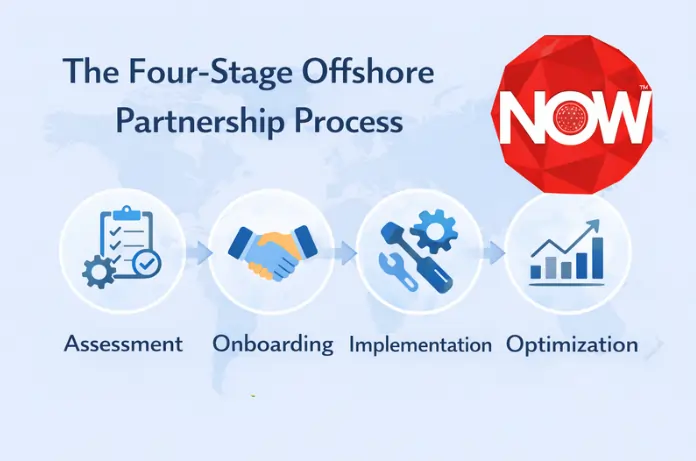
Offshore support becomes more stable when the partnership follows a clear operating structure. Without structure, offshore help can become reactive, fragile, and too dependent on individual effort. With structure, it becomes easier to define fit, transfer work cleanly, embed the team into existing systems, and scale without constant rebuilding.
NOW’s live How We Work page gives that structure directly. It says the offshore partnership model follows four stages:
- Qualification
- Structured Onboarding
- Team Build & Embed
- Operate & Scale
The same page says the model is designed to prioritize clarity, continuity, and operational stability so offshore teams strengthen delivery rather than add management overhead.
Stage 1: Qualification
NOW says Qualification is used to assess:
- long-term intent
- scope clarity
- operational readiness
This matters because offshore support works best when the business understands what problem it is solving and what work should move offshore first.
Stage 2: Structured Onboarding
NOW says Structured Onboarding establishes:
- clear roles
- documented workflows
- ownership
to enable clean handover and stable delivery.
That makes onboarding more than orientation. It becomes the mechanism that reduces confusion before the work goes live.
Stage 3: Team Build & Embed
NOW says Team Build & Embed is where dedicated offshore teams are aligned to:
- existing tools
- existing processes
- escalation paths
This is where support becomes embedded into the workflow rather than sitting outside it.
Stage 4: Operate & Scale
NOW says Operate & Scale means maintaining:
- continuity
- governance
while scaling output without constant retraining or intervention.
That is the stage where offshore support starts functioning like a stable layer of the business.
Why the four stages matter
Each stage reduces a different risk:
- qualification reduces misalignment
- onboarding reduces confusion
- build and embed reduces detachment
- operate and scale reduces instability during growth
Final thought
The four-stage offshore partnership process matters because offshore support becomes stronger when it follows a defined operating model. NOW’s live site already presents that structure clearly: qualification, onboarding, embedding, and scale.
FAQs
- What is the four-stage offshore partnership process?
It is NOW’s operating model: qualification, structured onboarding, team build and embed, and operate and scale. - Why does NOW use a four-stage process?
To support clarity, continuity, and operational stability. - What happens during qualification?
NOW says qualification assesses long-term intent, scope clarity, and operational readiness. - What happens during structured onboarding?
NOW says onboarding establishes clear roles, documented workflows, and ownership. - What happens during team build and embed?
NOW says dedicated offshore teams are aligned to existing tools, processes, and escalation paths. - What happens during operate and scale?
NOW says continuity and governance are maintained while output scales without constant retraining or intervention. - Why is qualification important?
Because it reduces misalignment before the work starts. This is an inference supported by NOW’s description of the stage. - Why is structured onboarding important?
Because it creates clarity before handover and supports stable delivery. - Why does embedding matter?
Because support performs better when it is aligned to the client’s actual systems and workflow. - Why does governance matter during scale?
Because governance supports continuity and reduces the need for constant intervention. - Is this process built for short-term staffing?
No. NOW says the model is for long-term offshore operations capability, not short-term staffing. - What kind of companies fit this process?
NOW says it works best for organizations evaluating offshore operations as a long-term operating decision. - Can this process reduce operational risk?
Yes. NOW says its model is designed to reduce operational risk. - Can this process reduce management overhead?
Yes. NOW says it helps businesses reduce management overhead while improving efficiency and continuity. - Does the process apply across industries?
Yes. NOW says the underlying model remains consistent while workflows and documentation requirements are adapted by industry. - What makes this different from ad hoc outsourcing?
NOW says the model is process-driven, not ad hoc. - Does this process support sales-driven organizations?
Yes. NOW applies the model to sales-driven organizations through revenue-operations support. - Can this process improve continuity?
Yes. Continuity is explicitly part of the model. - Can the process support scale without rebuilding?
Yes. NOW says operate and scale is designed to avoid constant retraining or intervention. - Why choose NOW’s four-stage process?
Because NOW says it supports long-term offshore stability, defined ownership, and reliable delivery since 2007.