

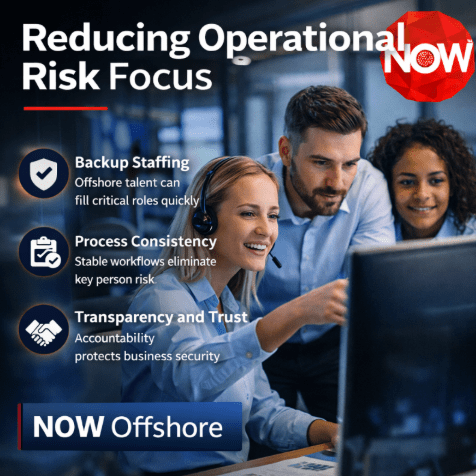
Reducing operational risk focus means prioritizing stability over cost, documentation over speed, and long-term partnership over short-term experiments. Since 2007, NOW works with leaders who want to reduce operational risk, not manage more people.
Introduction: Two Kinds of Leaders
There are two kinds of leaders when it comes to offshore teams.
First kind: Wants to manage more people. Sees offshore as adding headcount. Focuses on cost per hour.
Second kind: Wants to reduce operational risk. Sees offshore as adding stability. Focuses on continuity and quality.
According to Now Can Do It, NOW works best with leaders who want to reduce operational risk, not manage more people.
This article is part of the Ideal Client Profile series.
What Reducing Operational Risk Means
Reducing operational risk means eliminating the things that cause disruption.
Operational risks include:
| Risk | Description |
|---|---|
| High turnover | Constant retraining, lost knowledge |
| Undocumented processes | Knowledge leaves when people leave |
| Unclear ownership | Tasks fall through cracks |
| No escalation paths | Issues go unresolved |
| Quality inconsistency | Errors and rework |
Reducing these risks requires:
- Low turnover
- Documented workflows
- Clear ownership
- Defined escalation paths
- Consistent quality
Two Leadership Mindsets Compared
| Factor | Manage More People | Reduce Operational Risk |
|---|---|---|
| Focus | Headcount | Stability |
| Priority | Cost per hour | Continuity |
| View of turnover | Acceptable | Unacceptable |
| Documentation | Nice to have | Essential |
| Time horizon | Short-term | Long-term |
| Relationship | Vendor | Partner |
“Want to reduce operational risk, not manage more people” — NOW
The “Manage More People” Trap
Leaders who just want to manage more people often fail.
Why this approach fails:
| Mistake | Consequence |
|---|---|
| Focus on cost per hour | Hidden costs ignored |
| Accept high turnover | Constant retraining |
| Skip documentation | Knowledge lost |
| No ownership | Tasks fall through cracks |
| Short-term mindset | No institutional memory |
The result: You end up managing more people AND dealing with constant chaos.
The “Reduce Operational Risk” Approach
Leaders who focus on reducing operational risk succeed.
Why this approach succeeds:
| Action | Benefit |
|---|---|
| Focus on stability | Low turnover, preserved memory |
| Invest in documentation | Knowledge survives |
| Define ownership | Accountability clear |
| Create escalation paths | Issues resolved quickly |
| Long-term mindset | Value compounds |
The result: You reduce operational risk AND get stability.
How Reducing Operational Risk Benefits You
Focusing on operational risk reduction creates multiple benefits.
Direct benefits:
- Less time firefighting
- Fewer operational disruptions
- Consistent quality
- Lower management overhead
- Protected revenue continuity
Indirect benefits:
- Onshore teams less stressed
- Clients happier
- Scalability enabled
- Competitive advantage
How NOW Enables Risk Reduction
NOW is designed specifically for reducing operational risk.
NOW’s risk reduction model:
| Risk | NOW Solution |
|---|---|
| High turnover | Low turnover through long-term focus |
| Undocumented processes | Documented workflows in onboarding |
| Unclear ownership | Clear ownership defined |
| No escalation paths | Escalation paths documented |
| Quality inconsistency | Process-driven execution |
How Risk Reduction Aligns with Operational Stability
Reducing operational risk directly enables Operational Stability and Risk Reduction.
| Focus | Result |
|---|---|
| Reduce turnover | Institutional memory preserved |
| Document workflows | Knowledge survives |
| Define ownership | Accountability clear |
| Create escalation paths | Issues resolved |
| Long-term mindset | Value compounds |
FAQs About Reducing Operational Risk Focus
What does “reducing operational risk focus” mean?
Prioritizing stability over cost. Documentation over speed. Long-term partnership over short-term experiments. Wanting to reduce risk, not manage more people.
How is this different from traditional outsourcing?
Traditional outsourcing focuses on cost per hour and headcount. Risk reduction focus focuses on stability, continuity, and quality.
Why do some leaders focus on managing more people?
Pressure to show headcount growth. Misunderstanding of offshore value. Lack of experience with operational risk.
Why does the “manage more people” approach fail?
It ignores hidden costs like retraining, errors, and delays. You end up managing more people AND dealing with constant chaos.
What is the cost of ignoring operational risk?
Constant firefighting. Lost institutional memory. Revenue leaks. Frustrated onshore teams. High turnover.
What are the biggest operational risks in offshore?
High turnover, undocumented processes, unclear ownership, no escalation paths, and quality inconsistency.
How does high turnover create operational risk?
Constant retraining. Lost process knowledge. Inconsistent quality. Frustrated onshore managers.
How do undocumented processes create risk?
Knowledge leaves when people leave. New members cannot learn quickly. Quality varies.
How does unclear ownership create risk?
Tasks fall through cracks. No one feels responsible. Issues go unresolved.
How does lack of escalation paths create risk?
Problems become crises. No one knows who to contact. Resolution is delayed.
How does NOW reduce turnover risk?
Through long-term client commitment, documented workflows, clear ownership, and process-driven environment.
How does NOW reduce documentation risk?
Structured onboarding creates documented workflows for every process. Knowledge survives personnel changes.
How does NOW reduce ownership risk?
Clear roles and defined ownership are established upfront. Every task has an owner.
How does NOW reduce escalation risk?
Escalation paths are documented. Everyone knows who to contact for each issue type.
How does NOW reduce quality risk?
Process-driven execution ensures consistency. Quality standards are defined and followed.
How can I assess if I have risk reduction focus?
Ask: Do I prioritize stability over cost? Do I invest in documentation? Do I want to reduce risk, not manage more people?
What if my organization focuses on cost per hour?
You may not be ready for NOW. Price-first outsourcing is not a fit.
Can I shift from cost focus to risk reduction focus?
Yes. Start by calculating hidden costs of turnover and errors. The math often favors risk reduction.
What is the ROI of risk reduction?
Less firefighting. Fewer disruptions. Consistent quality. Lower management overhead. Protected revenue.
How can I learn more about reducing operational risk with NOW?
Visit Now Can Do It or contact rica@nowcandoit.com.