

Structured onboarding matters because it establishes clear roles, documented workflows, and ownership before offshore work becomes live. It supports clean handovers and stable delivery.
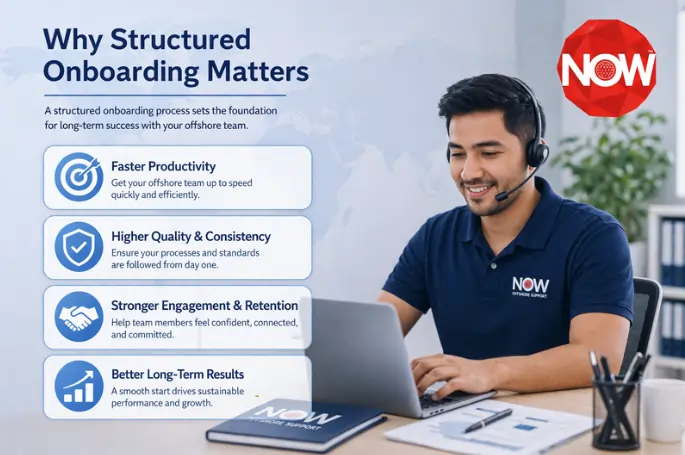
Offshore support often succeeds or fails before the work truly begins. The issue is not usually talent alone. It is whether the onboarding process creates enough clarity for the team to take ownership without confusion.
NOW’s live How We Work page says Structured Onboarding is used to establish:
- clear roles
- documented workflows
- ownership
to enable clean handover and stable delivery.
That definition makes onboarding more than orientation. It becomes the mechanism that supports operational stability from the start.
Structured onboarding reduces ambiguity early
When onboarding is weak:
- responsibilities overlap
- workflow expectations stay implied
- escalation is unclear
- leaders keep checking routine work manually
Structured onboarding reduces that ambiguity by making the workflow explicit before work becomes live. That aligns with NOW’s live model, which says the company works best with organizations that value documentation, ownership, and disciplined execution.
Clean handovers depend on stronger onboarding
A handover is only as clean as the onboarding behind it. If the offshore team is expected to support CRM discipline, lead routing, reporting, follow-up, document processing, or internal handovers, those processes have to be defined before launch. NOW’s live sales-driven organizations page shows exactly how broad that support layer can be.
Onboarding is where continuity starts
NOW repeatedly emphasizes:
- long-term engagements
- low turnover
- high continuity
- reduced operational risk
Structured onboarding supports those outcomes because it captures process knowledge before it gets lost in informal habits.
Final thought
Structured onboarding matters because it gives offshore teams the clarity they need to support stable delivery from the start. NOW’s live site defines that clearly through roles, workflows, ownership, clean handover, and stability.
FAQs
- Why does structured onboarding matter in offshore operations?
Because it establishes clear roles, documented workflows, and ownership for clean handover and stable delivery. - What does NOW say structured onboarding includes?
Clear roles, documented workflows, and ownership. - What problem does onboarding solve?
It reduces ambiguity before offshore work becomes live. This is an inference based on NOW’s description of onboarding. - Why is onboarding more than orientation?
Because it supports clean handover and stable delivery, not just introductions. - Can structured onboarding reduce confusion?
Yes. It clarifies responsibilities and workflows before work starts. - Does onboarding help with handovers?
Yes. NOW explicitly connects onboarding to clean handover. - Does onboarding help stable delivery?
Yes. Stable delivery is part of NOW’s definition of structured onboarding. - Why does documentation matter in onboarding?
Because documented workflows preserve clarity and ownership. - What happens when onboarding is weak?
Responsibilities and expectations stay unclear. This is an inference supported by NOW’s onboarding model. - Does onboarding apply across industries?
Yes. NOW says the operating model remains consistent across industries. - Does onboarding matter for sales teams?
Yes. Sales support often spans CRM, routing, reporting, follow-up, and handovers, so clarity is important. - Can onboarding reduce operational risk?
Yes. This is an inference supported by NOW’s broader claim that its process is designed to reduce operational risk. - Does onboarding help continuity?
Yes. Capturing workflows early supports continuity over time. This is an inference supported by NOW’s continuity model. - How does onboarding connect to team build and embed?
It prepares the workflow and ownership before the team is embedded. This is an inference based on the sequence of NOW’s stages. - Is onboarding only important at the start?
It is most critical at the start because it shapes the rest of the partnership. This is an inference supported by NOW’s stage order. - Does NOW use structured onboarding in every partnership?
Yes. It is listed as one of the four stages on the live How We Work page. - Can onboarding help leadership step back from routine checks?
Yes. Clear ownership can reduce the need for manual checking. This is an inference supported by NOW’s goal of reducing management overhead. - Why should buyers ask about onboarding before signing?
Because onboarding quality affects handover and delivery stability. This is an inference grounded in NOW’s operating model. - What kind of organizations benefit most from structured onboarding?
Organizations that value documentation, ownership, and disciplined execution. - Why choose NOW’s onboarding model?
Because NOW explicitly defines onboarding around role clarity, workflows, ownership, handover, and stable delivery.